- drainage
- waterproofing
French Drains in a Basement: When They're the Right Fix
Will a French drain fix your wet basement, or do you need a sump pump or interior waterproofing? A diagnostic guide to telling the difference. Free inspection.
By Basement Medic Team ·
A French drain is the right fix for a basement when you have real water coming in at or below floor level and you want a reliable way to collect and remove it. In a basement, that means an interior subslab drain: a gravel-bedded perforated pipe installed under the floor slab against the inside of the foundation wall, pitched to a sump pump that discharges outside. It is the wrong fix when the wall is only stained or damp with no standing water, when the problem is humidity, or when a wall is cracking and bowing. In a wet basement the drain and the sump pump are one system, not competing choices: the drain collects and moves the water, and the pump removes it from the basement. This guide helps you tell which situation you are in before you spend money on the wrong solution.
What a French Drain Actually Is
A French drain is a gravel-filled trench with a perforated pipe at the bottom. Water collects in the gravel, drips into the pipe, and the pipe carries it to a lower point where a pump can remove it. The same term covers two different installations, which is where homeowners get confused. An exterior French drain sits in the yard soil and moves surface water away from the house, which is a grading and drainage job. An interior French drain sits under the basement slab against the foundation wall and handles water that is already getting in. When a basement contractor recommends a French drain for a wet basement, they almost always mean the interior version.
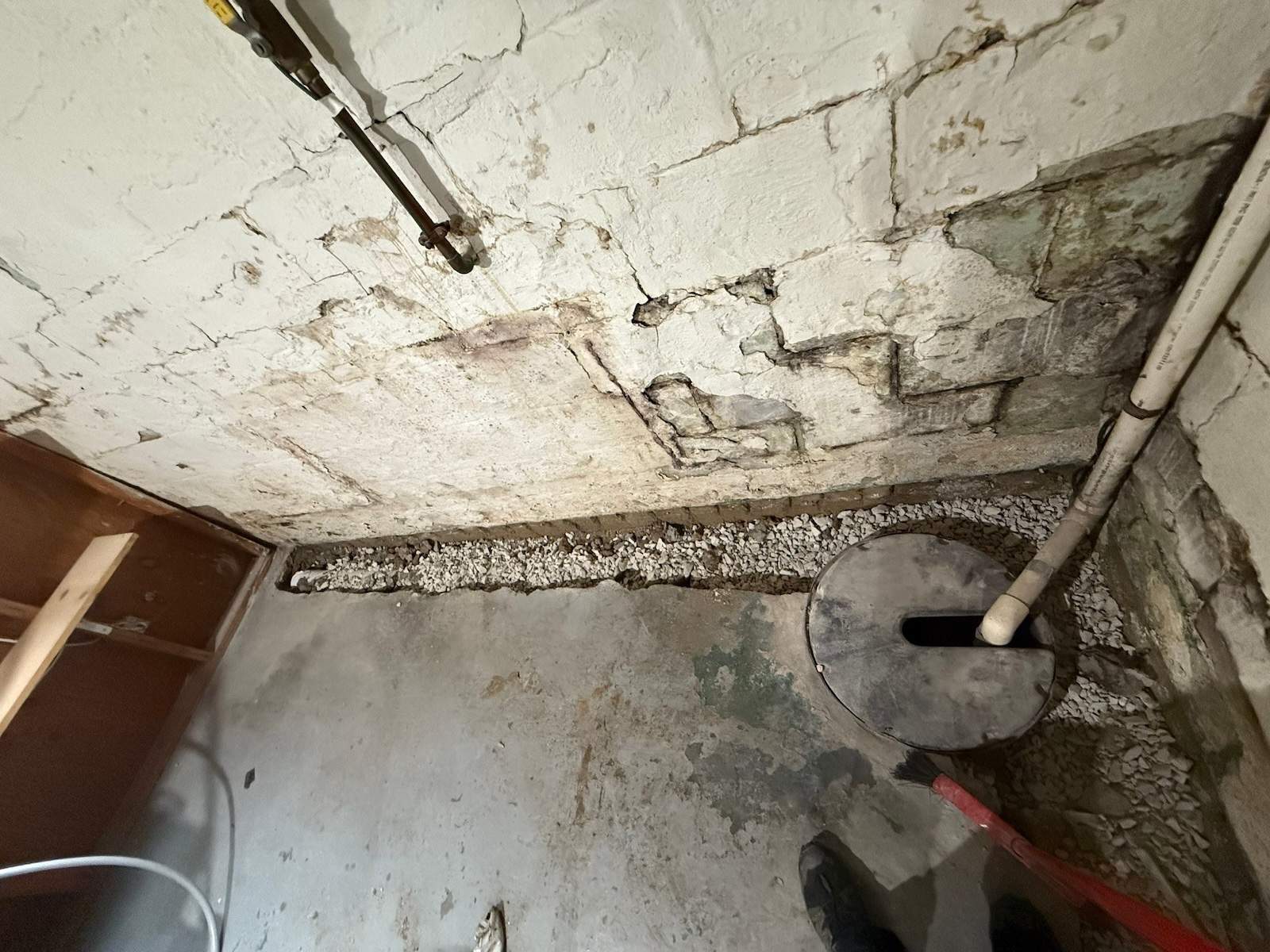
The interior drain is built into the slab. Crews cut and remove a perimeter strip of concrete, dig a trench about 10 inches by 10 inches beside or below the footer, lay 4-inch pipe in gravel, and poke weep holes in the bottom course of block so water in the wall drains into the trench.
Start With the Symptom, Not the Solution
Different symptoms point to different fixes, so be honest about what your basement is actually doing before you pick a system.
- Standing water or flooding on the floor. This is active intrusion, and it is the clearest sign you need a perimeter drain and a sump pump. Water can come through the wall, through the mortar joints, through the slab-to-wall joint, or low on the wall and across the floor.
- Staining, chalky efflorescence, or damp patches but no standing water. Block walls act like sponges and pull moisture through. Discoloration on the wall is moisture wicking, not necessarily water coming in, and on its own it does not call for a drain and sump.
- A musty smell or high humidity with a dry floor. This points to a moisture and humidity problem, often handled with a dehumidifier and better outside water management, not a drain. There is no flowing water for a drain to collect.
When a French Drain Is the Right Fix
An interior French drain tied to a sump pump is the right solution when you have frequent or substantial water entering at or below floor level. It is usually the better choice than digging up the outside of the house, because garages, driveways, landscaping, and neighboring structures often make full exterior excavation impractical. The interior drain reaches the same goal with far less disruption. The trench can be topped with gravel in an unfinished basement to save cost, or topped with concrete so flooring goes over it and the system stays hidden, which is what lets a finished basement stay dry and hold its value. This is the core of our basement drains and interior basement waterproofing work.
When a French Drain Is Not the Answer
A French drain is the wrong starting point when you only have moisture wicking or efflorescence, when the real issue is humidity, or when the water traces to a single fixable source like a downspout dumping against the foundation or a backed-up exterior stairwell drain. It is also not a structural fix. If a wall is cracking or bowing, the wall has to be reinforced on its own track, and progressive settlement is handled with deep-foundation methods that Basement Medic does not offer and will refer out.
French Drain and Sump Pump Work Together
Treating a French drain and a sump pump as competing options is a common mistake. The drain collects water around the perimeter and moves it. The pump removes the collected water and discharges it outside. A drain with nowhere to send water does not solve the problem, and a sump pump that water cannot reach does not either.
"A basement can have a sump pump that works perfectly and still flood, because the water is coming in on the far side of the room and has no way to get to the pump. That is the whole reason we run the perimeter drain: to collect the water and carry it to the pit."
— Rick, Basement Medic operator
A Quick Self-Check Before You Call
- Is there standing water or flooding on the floor? If yes, you likely need a perimeter drain and a sump pump.
- Is the floor dry but the walls stained or chalky? If yes, look at humidity control and outside water first.
- Is the air musty or humid with no visible water? If yes, a dehumidifier and a source check come before any drain.
- Do you see a horizontal crack or a wall bowing inward? If yes, that is a structural issue to address alongside any drainage.
- Have you checked downspouts, grading, and exterior drains? Fixing an obvious surface source is cheaper than interior work.
What It Costs
An interior drain and sump pump system runs about $6,000 to $12,000 for an average basement, a 2 to 4 day job, and reaches $15,000 or more on larger 200-foot jobs; across basement sizes the broad range is roughly $3,000 to $30,000, driven mostly by basement size and linear feet of drain. A sump pump on its own runs about $750 to $2,000. The inspection sets the scope, not a price list.
Questions to Ask Before You Hire
- Will the drain sit beside or below the footer, or on top of it? Keeping it off the footer avoids undermining the foundation.
- Are you recommending a drain because there is standing water, or because of staining I could handle another way?
- Will the trench be topped with gravel or concrete, based on how I plan to use the space?
- Does my situation call for a battery backup pump?
French Drain Basement FAQs
Is a French drain the same as a sump pump?
No. A French drain collects and moves water; a sump pump removes the collected water from the basement and discharges it outside. In a wet basement they work together as one system.
Do I need an interior or exterior French drain for my basement?
Most wet basements are handled with an interior subslab drain, because exterior excavation is often blocked by garages, driveways, and landscaping. The interior drain is installed under the slab against the foundation wall.
Will a French drain fix a damp, musty basement with no standing water?
Usually not on its own. Staining and musty air without liquid water point to humidity or moisture wicking through the block, which a dehumidifier and outside water management address better than a drain.
Why does my basement still flood if I already have a sump pump?
Often the water enters far from the pit with no drainage path to reach the pump, so the pump runs fine while water pools elsewhere. Adding perimeter drainage to carry water to the pit closes that gap.
Can a French drain go in a finished basement?
Yes. The drain goes under the slab and the trench is topped with concrete so flooring installs over it and the system stays hidden, which helps a finished basement stay dry.
Not Sure Which Fix Your Basement Needs?
A Basement Medic inspection finds where the water is actually coming in and recommends the system that fits your home. You decide from there. Schedule your free inspection to get a clear diagnosis.
Recent Posts
Seeing Signs of a Basement Problem?
Water stains on the walls, damp or efflorescent block, a musty smell after every storm, hairline cracks that keep growing — these are the early warnings most homeowners ignore. Book a free Basement Medic inspection and we'll tell you exactly what's causing it and what it actually takes to fix.