- wall-repair
- carbon-fiber
Carbon Fiber Straps for Basement Walls: What Works
Carbon fiber straps are sold for every cracked basement wall. Learn when they work, when steel braces are better, and the install red flags to watch for.
By Basement Medic Team ·
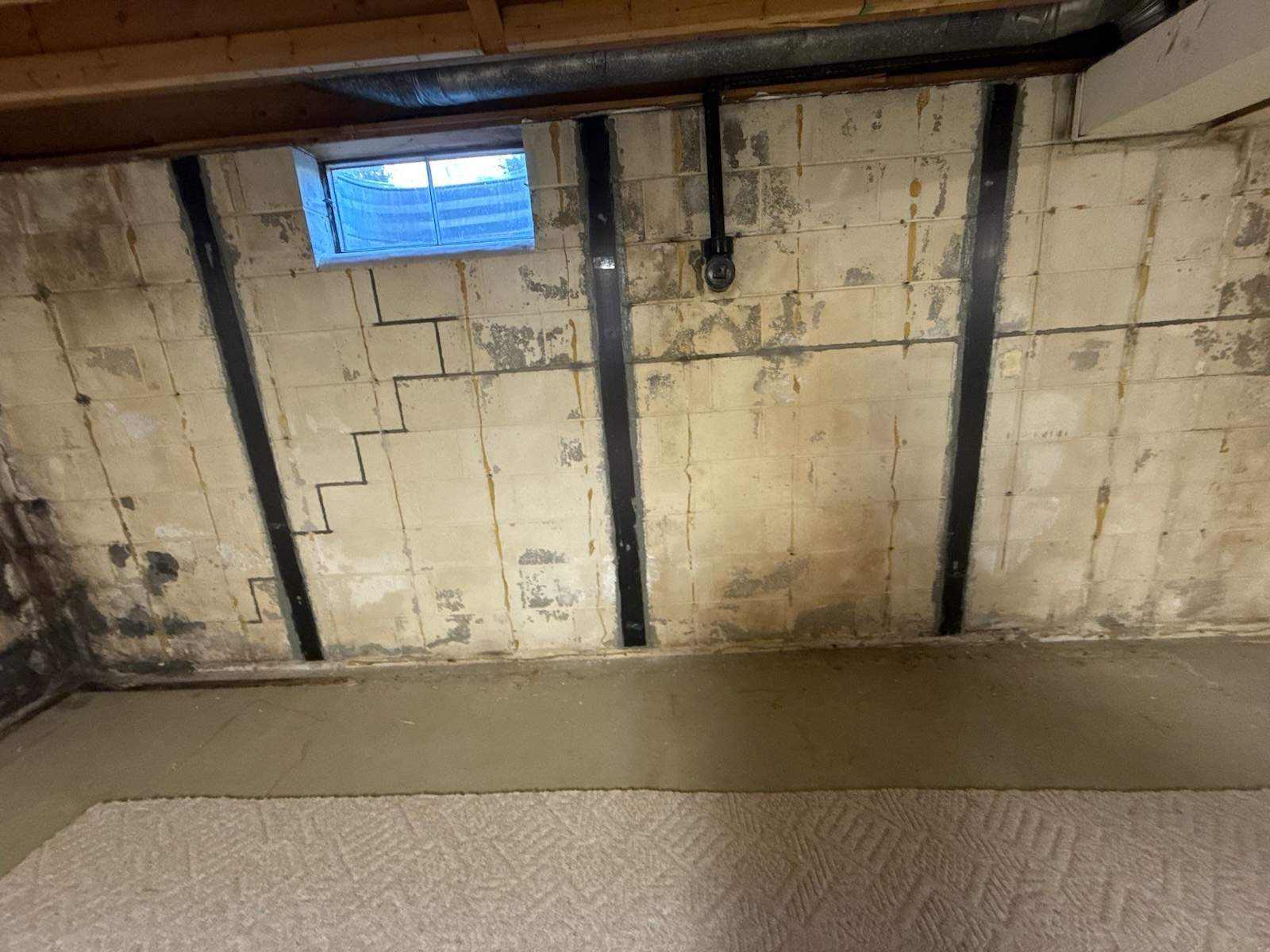
Carbon fiber straps work on a basement wall when the wall has early bowing or a horizontal crack caused by soil and water pushing in from outside. The straps are bonded to the inside face of the wall with epoxy to stiffen it and stop further movement; they hold the wall in place but do not push it back. They are not right for every wall. When a wall has moved further or is under heavy inward pressure, steel I-beams or wall braces are the better tool. And the product matters less than the install: straps only hold if the wall is sanded and the cracks are filled to a smooth surface first. This guide explains where carbon fiber genuinely works, where steel is the smarter choice, and how to spot an install being done the wrong way.
What Carbon Fiber Straps Do
Carbon fiber straps are flat strips of carbon fiber fabric bonded to the inside of a foundation wall with epoxy, running vertically and anchored at the floor and the top of the wall. Their job is to add tensile strength so the wall stops moving. When saturated soil and water press against a basement wall, the wall wants to bend or crack inward, and the straps resist that pull. Two things follow from that. The straps stabilize a wall in its current position rather than returning it to where it started, and they work best while the movement is still minor.
When Carbon Fiber Straps Are the Right Choice
Carbon fiber is appropriate when a wall shows early signs of lateral movement from outside pressure. The clearest signals are a horizontal crack running across the wall and a visible bulge in the middle of it. A bulge in the middle of the wall is the first sign of lateral failure, and it lines up with a heavy amount of water and soil pushing the wall inward. Crack width is a useful guide here. Cracks under about a quarter inch are generally less urgent, cracks over a quarter inch are more concerning, and any horizontal crack is a structural concern no matter its width, because it signals the wall being pushed in. Straps are spaced about every 3 feet across the affected section, and the number a wall needs is measured from the affected area rather than quoted flat. This is the work we do on our basement wall crack repair projects.
When Steel Braces Are the Better Tool
Carbon fiber is not the strongest option for every bowing wall. When a wall is under heavy inward pressure or has already moved a significant amount, steel I-beams or wall braces are preferred. Steel braces anchor to the floor and the joists above and can sometimes be tightened over time to recover some of the wall's position, which carbon fiber cannot do. The general rule is straightforward: the further a wall has bowed and the heavier the pressure behind it, the more likely steel is the right answer. A contractor who recommends carbon fiber for every wall regardless of how far it has moved is selling a product, not matching the fix to the wall.
The Install Is Where Quality Lives
The straps themselves are similar across the industry. What separates a repair that holds from one that fails is the surface prep, and that work disappears once the wall is finished. The bond is only as good as the surface under it.
"If you don't sand the wall down and fill all the cracks with concrete to make a smooth barrier, the straps don't hold as well. Thrown up there with one coat of epoxy, they don't work as good. The detail in putting them in is the difference."
— Daniel, Basement Medic installer
A proper install follows a sequence. The wall is sanded so the epoxy has a clean surface to grip, existing cracks are filled with concrete or mortar so the surface is sound, the epoxy is applied correctly, and the strap is bonded with full contact. Because all of that is hidden behind the finished wall later, the questions you ask before the work matter more than anything you can check after.
Red Flags of a Bad Carbon Fiber Install
- Carbon fiber recommended for every wall regardless of how far it has bowed. Heavily moved walls may need steel.
- No surface prep: straps applied over a rough, unfilled wall with a single quick coat of epoxy.
- Straps spaced well beyond about 3 feet, leaving too much unsupported wall between them.
- No attention to the water behind the wall. Cracks and water usually go together, so reinforcement without drainage leaves the wall fighting the same load.
- A horizontal crack treated as cosmetic or simply filled and painted.
Cracks That Carbon Fiber Does Not Fix
Carbon fiber is for walls bowing under lateral pressure, not for every crack. Stair-step cracks that follow the mortar joints are often a settlement issue, and in newer homes some settlement is normal in the first year or two. The way to tell whether it is active is to monitor it: place a bead of construction adhesive across the crack and watch it, and if it widens, address it; if it stays the same, it is likely just settlement. Progressive settlement is handled with deep-foundation methods that Basement Medic does not offer and will refer out, not with carbon fiber straps.
Often the pressure behind a bowing wall comes from water in the soil, so a lasting fix pairs wall reinforcement with basement waterproofing or an interior drainage system that relieves the load.
What It Costs
Basement wall crack repair runs roughly $3,000 to $6,000 depending on how many straps or braces the wall needs, and broader structural wall-repair work ranges to about $3,000 to $15,000. A carbon fiber strap runs about $750 as an installed unit, so the total tracks the number the wall requires. Be cautious of a flat quote given without anyone measuring the wall, and treat any figure as a planning range until an inspection sets the scope.
Carbon Fiber Basement Wall FAQs
Do carbon fiber straps actually work on basement walls?
Yes, in the right conditions. They stop further movement in walls with minor bowing or a horizontal crack from soil and water pressure. They hold the wall in place rather than pushing it back, and they are not the best tool for walls that have already moved a lot.
Carbon fiber straps or steel braces, which is better?
It depends on how far the wall has moved. Carbon fiber suits earlier, lower-movement walls; steel braces are preferred for heavier inward pressure or walls that have bowed further, and they can sometimes recover part of the wall's position.
How far apart should carbon fiber straps be spaced?
About every 3 feet across the affected section of wall, with the count based on the size of the affected area rather than a flat number.
Do I still need to fix the water if I install carbon fiber straps?
Usually yes. Cracks and water go hand in hand, and the pressure that bowed the wall often comes from saturated soil, so reinforcing the wall without managing the water leaves it fighting the same load.
Is a stair-step crack a structural problem?
Often it is settlement, especially in newer homes. Monitor it with construction adhesive across the crack; if it widens it needs attention, and if it stays the same it is likely normal settling. A horizontal crack, by contrast, is a structural concern regardless of width.
Worried About a Cracking or Bowing Basement Wall?
A Basement Medic inspection diagnoses the cause and severity first, then recommends carbon fiber, steel reinforcement, or a combination based on what the wall needs. Schedule your free inspection and we'll tell you what the wall actually needs.
Recent Posts
Seeing Signs of a Basement Problem?
Water stains on the walls, damp or efflorescent block, a musty smell after every storm, hairline cracks that keep growing — these are the early warnings most homeowners ignore. Book a free Basement Medic inspection and we'll tell you exactly what's causing it and what it actually takes to fix.